
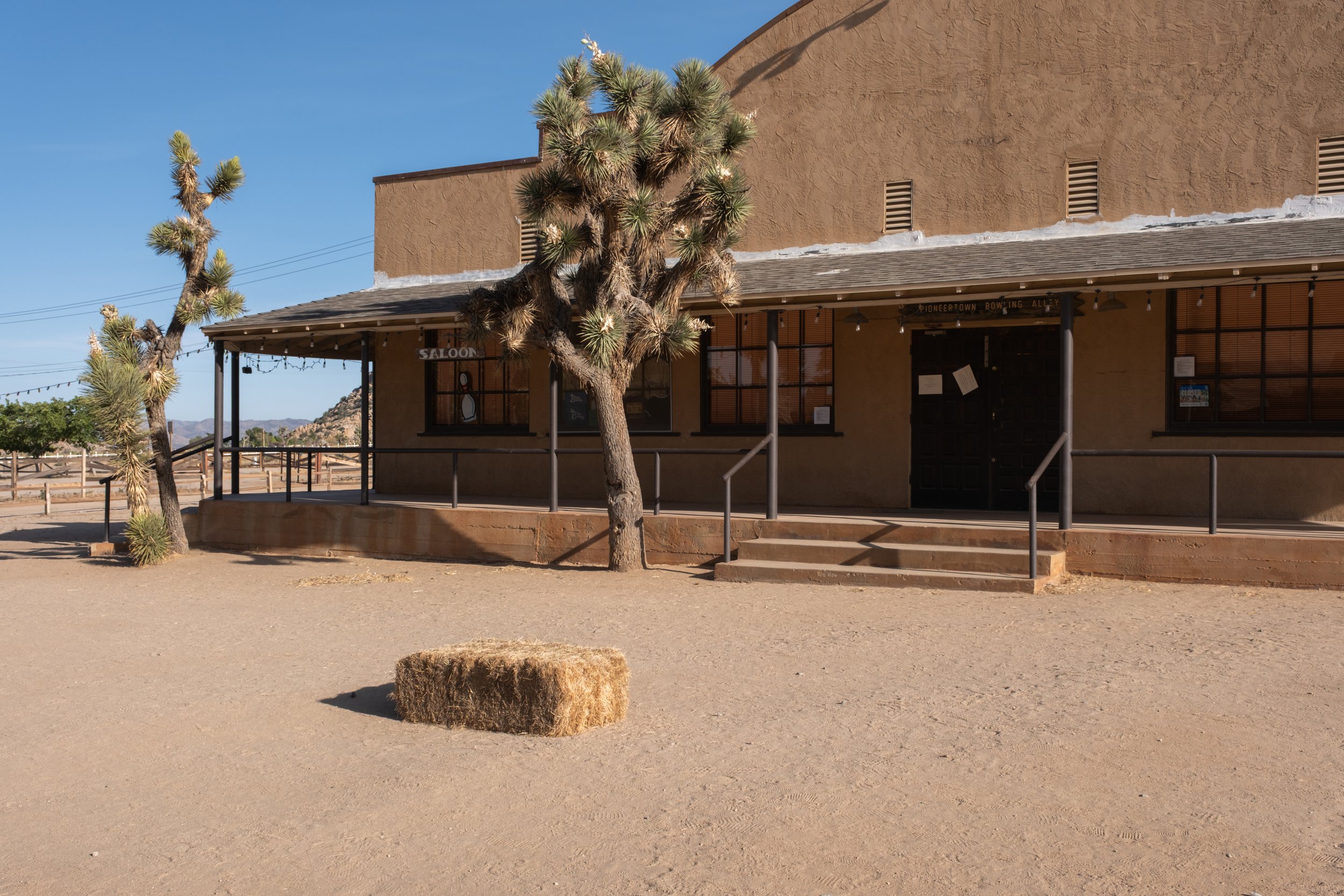
Photography © Paul Martinez
Before Pioneertown became a Hollywood Western destination, its founders had their sights set on a very different location.
There is a stretch of desert within Joshua Tree National Park where granite formations rise above the valley floor, Joshua trees stand scattered across the landscape, and little suggests that this place was once considered for an entirely different future.
In 1945, Hollywood actor Dick Curtis set his sights on approximately 3,500 acres in Lost Horse Valley. His vision was ambitious: a permanent Western movie town where filmmakers could work, actors could stay, and visitors could experience the Old West. But there was just one problem. The land was located within Joshua Tree National Monument.
Although the area had received federal protection in 1936, portions of the land within its boundaries remained privately owned. When the National Park Service learned of Curtis's plans, officials faced the possibility of a substantial Hollywood development taking shape in the heart of the monument. What followed was a complicated series of negotiations involving a railroad, federal agencies, conservation advocates, and a group of Hollywood investors.
The outcome would help shape two destinations that millions of people recognize today: Joshua Tree National Park and Pioneertown.
Hollywood Sets Its Sights on the Desert
By the mid-1940s, the American Western had become a defining genre of Hollywood filmmaking. Productions required vast landscapes, dramatic scenery, and enough open space to stage horseback chases, gunfights, and other scenes depicting the Old West. But filming on location came with challenges. Moving crews, constructing temporary sets, and transporting equipment could be expensive and time-consuming. The San Fernando Valley, long used for Western productions, was also becoming increasingly developed.
Dick Curtis, an actor who had appeared in numerous Western films, imagined a more permanent solution. Rather than repeatedly constructing and dismantling movie sets, Curtis envisioned an entire Western town built specifically for filmmaking. Behind its rustic storefronts would be functioning businesses, accommodations, and residences. It would be a place where the imaginary world of the movies and everyday life could coexist. And for a time, Lost Horse Valley appeared to offer the perfect setting.
The rugged landscape of Joshua Tree National Monument had already attracted filmmakers. The 1940 film Buck Benny Rides Again, starring Jack Benny, had used the monument as a filming location. Its granite formations and expansive valleys provided precisely the kind of natural scenery Curtis sought.
According to a National Park Service administrative history, on December 17, 1945, Curtis contacted Joshua Tree superintendent James Cole to announce his intention to purchase 3,447 acres from Southern Pacific Railroad. The proposed development included a permanent Western film set and accommodations for approximately 200 people. [1] For the National Park Service, the news was alarming.
A National Monument With a Complicated Ownership History
Today, it’s easy to assume that land within a national park has always belonged to the federal government. The history of Joshua Tree tells a more complicated story.
When President Franklin D. Roosevelt established Joshua Tree National Monument on August 10, 1936, the designation encompassed approximately 825,000 acres of desert. Yet the federal government did not own all the land within those boundaries. Southern Pacific Railroad controlled substantial parcels throughout the monument, a legacy of the railroad land grants that had divided portions of the American West into alternating sections of public and private ownership. This created a patchwork of ownership within the newly protected landscape.
For park officials, acquiring these privately held parcels was essential to protecting the monument from incompatible development. Curtis's proposal brought the issue into sharp focus. If the sale went forward, the National Park Service estimated that it would control only 26% of Lost Horse Valley and could lose control of part of the road connecting the valley to Keys View. Superintendent Cole regarded the situation as a serious threat to the monument's future. [1] But the government lacked sufficient funding to simply purchase all the remaining railroad lands. An alternative would have to be found.
The Deal That Changed the Desert
National Park Service Director Newton Drury began seeking ways to prevent the proposed development in Lost Horse Valley. When fundraising efforts proved unsuccessful, he turned to conservation advocates, including members of the Garden Society of America. One important connection emerged through Alma Chickering, whose husband, Allen L. Chickering, was the lead attorney for Southern Pacific Railroad and an established conservationist. Through his influence, the railroad agreed not to sell its Lost Horse Valley property to Curtis and his associates. Instead, the company offered land northwest of Yucca Valley, near the site where Pioneertown stands today. [1]
This opened the door to a more ambitious arrangement. Because Southern Pacific owned alternating sections of land in the proposed Pioneertown area, Curtis and his investors needed additional federal parcels to create a continuous property suitable for their development. The National Park Service saw an opportunity. Under a proposed three-party land exchange, Pioneertown's investors could assemble the property they wanted outside the monument while the federal government could acquire valuable railroad-owned land within it.
By April 1946, negotiations had advanced, and the parties supported the proposed arrangement. [2] What began as a potential conflict between development and conservation had become an opportunity to satisfy both interests. But completing the exchange would take considerably longer than anticipated.
From Lost Horse Valley to Pioneertown
While the land negotiations continued, construction began on the new Western town. Pioneertown officially broke ground on September 1, 1946. Among its early investors and supporters were familiar names from Hollywood, including Roy Rogers, Dale Evans, Russell Hayden, and members of the Sons of the Pioneers.
Unlike conventional movie sets, Pioneertown was designed to function as an actual community. Its buildings were more than empty facades. Visitors could stop at a saloon, stay at a motel, shop at local businesses, and walk along Mane Street, all while surrounded by the atmosphere of an Old West town. The project combined Hollywood spectacle with the ambitions of a growing desert settlement. [3]
Meanwhile, the complicated land negotiations involving the federal government, Southern Pacific Railroad, and Pioneertown continued. In April 1948, the National Park Service separately purchased 12,826 acres from Southern Pacific Railroad, strengthening federal ownership within the monument. Then, on October 20, 1948, the Bureau of Land Management approved the long-awaited exchange involving Pioneertown.
Through that agreement, the National Park Service acquired an additional 18,234 acres, primarily in and around Lost Horse Valley, while Pioneertown consolidated its holdings around the town already under construction. [2] The exchange faced legal challenges from individuals who had sought some of the federal parcels, but the decision was ultimately upheld. A plan that had once threatened the monument's landscape had instead contributed to its protection.
Two Destinations, One Shared History
Nearly eight decades later, Pioneertown and Joshua Tree National Park remain two of the High Desert's most recognizable destinations. Visitors walk the dusty length of Mane Street, admire its weathered wooden storefronts, and step into a place that still feels suspended somewhere between Hollywood fiction and the American West.
Elsewhere, within Joshua Tree National Park, Lost Horse Valley remains part of the protected desert landscape that first caught the attention of filmmakers. It is difficult to imagine what this area might look like today had Curtis succeeded in purchasing the land. Would a Western town have risen among the Joshua trees and granite formations? Would Lost Horse Valley have become a recognizable backdrop for generations of Hollywood productions?
Those questions belong to a history that never happened. What we do know is that the negotiations surrounding Pioneertown helped the National Park Service secure thousands of acres within Joshua Tree National Monument, contributing to the protection of a landscape whose future was far from certain. And perhaps that is what makes this story so fascinating. Two places that seem to exist in entirely different worlds, one built around the illusion of the Old West and the other protected for their natural and cultural significance, are connected by a decision made more than 80 years ago.
The next time you wander through Pioneertown or travel through Lost Horse Valley, consider how differently the desert might have looked. Sometimes, understanding a place means discovering not only what happened there, but what almost did.
Sources & Further Reading
[1] Lary M. Dilsaver, Joshua Tree National Park: A History of Preserving the Desert (National Park Service, 2015), Chapter 4, pp. 109–111. Documents Dick Curtis's December 1945 proposal, the proposed Lost Horse Valley development, the National Park Service's concerns, and efforts to redirect the project.
Read the National Park Service history (PDF)
[2] Dilsaver, Joshua Tree National Park: A History of Preserving the Desert, Chapter 4, pp. 111–113. Details the land negotiations, separate federal purchase of railroad acreage, and the October 20, 1948, approval of the Pioneertown exchange.
Read the land acquisition history (PDF)
[3] Pioneertown Mane Street Historic District, National Register of Historic Places registration form, Section 8. Documents the development's original vision, Hollywood investors, and the relationship between Pioneertown's film production facilities and functioning businesses.
Read the historic district documentation (PDF)
Additional historical reference
National Park Service, Joshua Tree National Park: Park History. Provides background on the monument's 1936 establishment and its designation as a national park in 1994.